
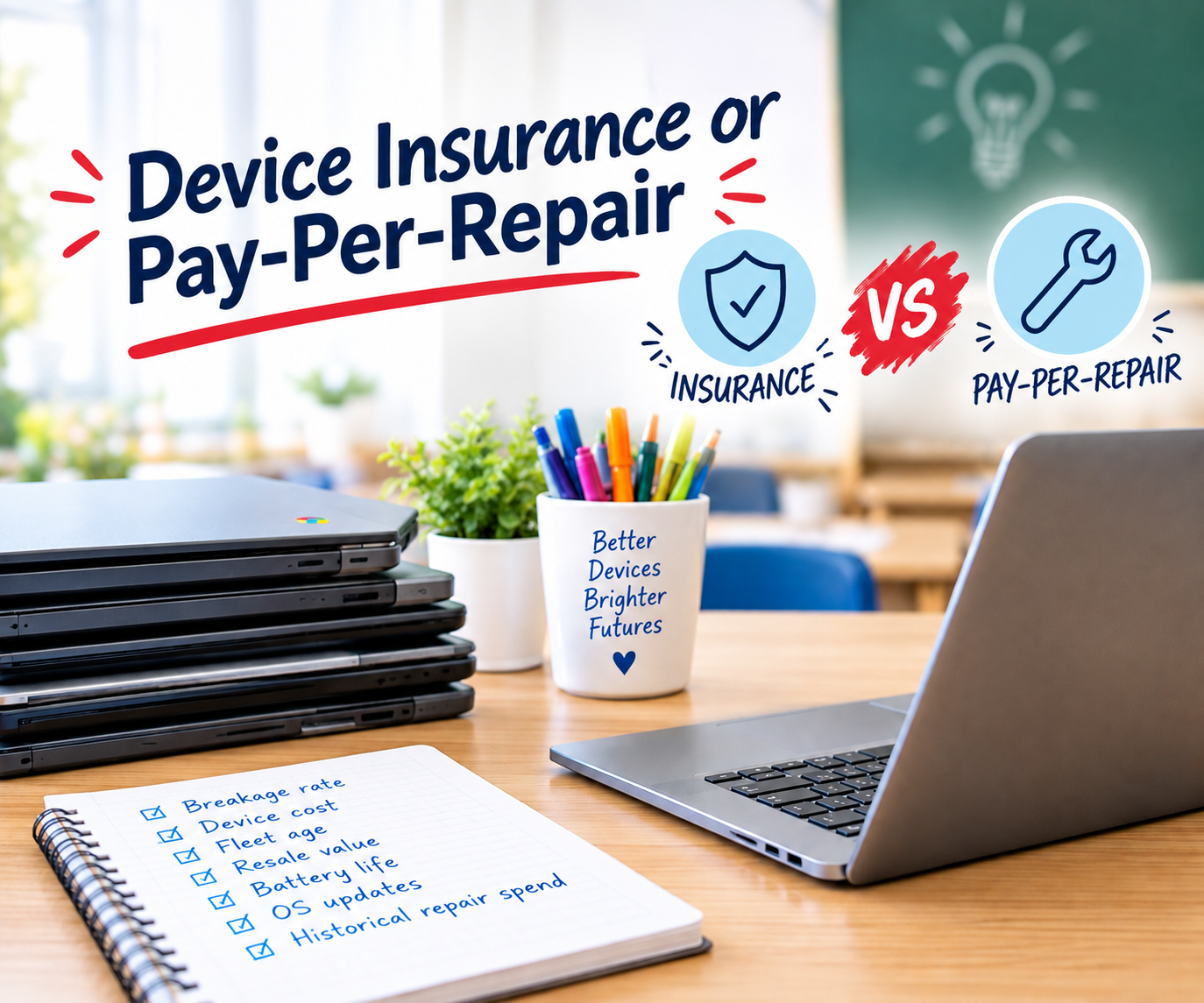
Device insurance or pay-per-repair? It’s a question we hear from schools all the time.
As a company that works directly with schools and insurance providers, we’re often asked: “In your opinion, which is better?”
The honest answer? It depends.
There isn’t one right answer for every school district. Device insurance can provide predictable costs and protection against unexpected repair expenses. Paying for repairs as they happen can give a school more control and may be more cost-effective for certain fleets.
The better question isn’t necessarily “Which option is better?” It’s: “Which option makes the most financial sense for our specific device fleet?”
Before making that decision, IT directors should take a close look at seven key factors.
1. What Is Your Actual Breakage Rate?
Start with the numbers you already have.
How many devices are actually being damaged or repaired each year? It can be tempting to assume that a large device fleet automatically means insurance is the safer choice. But if your school has a relatively low breakage rate, paying for repairs individually may be worth considering.
On the other hand, if you’re consistently repairing a significant percentage of your fleet every year, insurance may help make those costs more predictable.
Look at your historical data:
- How many devices were repaired last year?
- What percentage of your total fleet does that represent?
- What types of damage are most common?
- Are repairs becoming more or less frequent?
- Are certain grades, buildings, or device models experiencing more damage?
Your actual repair history is more useful than an industry average.
2. How Much Do Your Devices Cost?
The cost of the device itself should play a major role in your decision.
Consider a $250 Chromebook versus a $1,200 Macbook. The financial impact of a repair or replacement can look very different depending on the original cost of the device. But don’t just stop at the purchase price.
Consider the cost of:
- A replacement device
- A screen or display repair
- A keyboard or palmrest replacement
- A battery replacement
- Motherboard or board-level repairs
- Shipping and logistics
- Technician labor
- Accessories that may need to be replaced
Then compare those potential expenses against the cost of your insurance program. The goal is to understand your total cost of ownership and not just the price on the original purchase order.
3. How Old Is Your Device Fleet?
Age can significantly change the insurance-versus-repair equation.
A device that’s one year old may have several productive years ahead of it. A device that’s approaching the end of its useful life may be a different story.
Before choosing an option, ask: How much longer do we realistically expect to keep these devices?
If you’re replacing devices every three to four years, for example, paying to repair an older device may not always make sense if the repair cost is approaching the device’s remaining value. On the other hand, if your district has an extended device lifecycle, investing in repairs can help you get additional useful years out of your existing fleet.
Don’t just consider how old a device is. Consider how much useful life it has left.
4. What Is the Resale or Replacement Value of Your Devices?
This is one of the questions that can easily get overlooked.
A device may have originally cost $500, but that doesn’t mean it’s still worth $500, or even close to it, today.
Look at the current value of your devices and consider:
- What could the device be sold or traded in for?
- What would it cost to replace it with a comparable device?
- Is the device still desirable on the secondary market?
- How much value will it retain over the next 12–24 months?
This matters because repairing a device only makes financial sense when the value you get from that repair justifies the cost.
5. What Is the Battery Cycle Rate Telling You?
For schools with devices that have been in service for several years, battery health is another important piece of the puzzle.
A device may be physically repairable, but that doesn’t necessarily mean it’s worth continuing to repair. Battery cycle counts and overall battery health can help you understand where a device is in its lifecycle. If a large portion of your fleet is experiencing declining battery health, consider whether you’re looking at isolated repair needs or even a broader fleet replacement issue.
You may find that the question isn’t simply:
“Should we repair this device?”
It may be:
“How much longer should we continue investing in this device?”
Looking at battery health alongside breakage rates, age, and repair costs can give you a much clearer picture.
6. Will Your Devices Continue Receiving OS Updates?
A device can be in excellent physical condition and still be nearing the end of its useful life.
Operating system compatibility and update support should be part of your decision-making process.
Before investing heavily in repairs, determine:
- How long will this device continue receiving OS updates?
- Will it remain compatible with the applications students and teachers need?
- Is the manufacturer still supporting the device?
- Will the device remain secure and functional throughout your planned lifecycle?
There’s little value in putting significant repair dollars into a device that your school won’t be able to use effectively a year from now. Repair decisions should consider technological lifespan and not just physical condition.
7. What Does Your Total Repair Spend Look Like?
Finally, look at the big picture.
Instead of comparing insurance cost vs. individual repair cost, compare the total cost of each approach. Look at your historical numbers and estimate what you actually spent on repairs last year.
Consider:
- Repair costs
- Insurance premiums
- Deductibles
- Replacement devices
- Shipping
- Labor
- Administrative time
- Claims management
- Device downtime
- Expected repairs over the next few years
This can help you determine whether insurance is providing meaningful financial protection or whether your district may be better served by budgeting for repairs directly.
So, Which Is Better: Insurance or Pay-Per-Repair?
We wish there were a simple answer.
After working with schools and insurance providers, we’ve seen that both approaches can make sense depending on the district.
Device insurance may make sense if:
- Your breakage rate is consistently high.
- You need predictable annual costs.
- Your devices are relatively expensive to replace.
- Unexpected repair expenses would significantly impact your budget.
- You want to transfer some of the financial risk associated with accidental damage.
Pay-per-repair may make sense if:
- Your breakage rate is relatively low.
- Your devices are inexpensive to repair.
- You have a strong repair process already in place.
- You want more control over which devices receive repairs.
- Your fleet is older and approaching replacement.
- Your historical repair costs are consistently lower than the cost of insurance.
And sometimes, the answer isn’t exactly one or the other.
A school may choose to insure certain devices or students while paying for repairs on others. Another district may decide that insurance makes sense for a newer, higher-value fleet but that direct repair is more economical as those devices age.
The Bottom Line: Know Your Numbers
When you’re responsible for hundreds or thousands of school devices, it’s easy to make decisions based on what seems safest or what another district is doing.
But your fleet is unique.
Before deciding between device insurance and pay-per-repair, look at your own:
- Breakage rate
- Device cost
- Fleet age
- Resale value
- Battery health
- OS support
- Historical repair spending
Once you understand those numbers, the decision becomes much less about “Which option is better?” and much more about “Which option is better for our school?”
And that’s the question we recommend asking.
At iResQ, we work with schools to repair and maintain devices across their lifecycle. Whether your district uses device insurance or pays for repairs directly, having a reliable repair partner can help you get the most value out of the technology you’ve already invested in.